

Research reviewed and updated: August 13, 2026
To rank in AI search engines, do not optimize for a single hidden score. Improve the entire path that connects your content to an AI-generated answer:
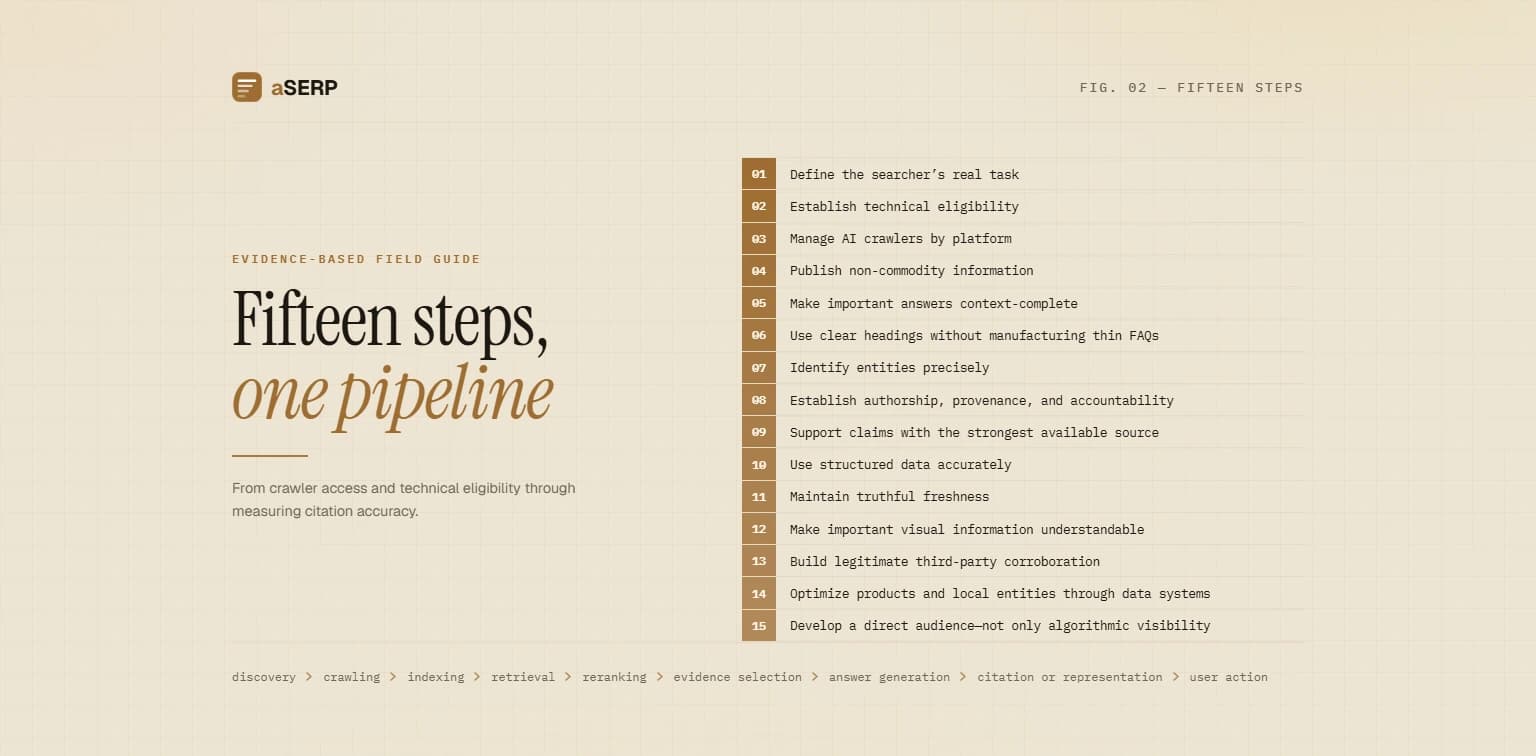
Discovery → crawling → indexing → retrieval → reranking → evidence selection → answer generation → citation or representation → user action
A page can rank well in traditional search yet fail to appear in an AI answer. It can also be retrieved but not selected, selected but not cited, cited inaccurately, or cited without receiving a click. That is why AI-search visibility cannot be measured through conventional keyword positions alone.
The most defensible strategy combines established search engine optimization with original evidence, clear content architecture, accurate entity information, platform-specific crawler access, transparent sourcing, and dedicated AI-visibility measurement. Google explicitly states that its existing SEO practices remain relevant to AI Overviews and AI Mode. Google also says publishers do not need special AI schema, an llms.txt file, tiny content fragments, or a separate “AI writing style” to appear in those Search experiences. [1] (Google for Developers)
The priorities that matter most
| Priority | What to do | Why it matters |
|---|---|---|
| Technical eligibility | Make strategic pages crawlable, indexable, canonical, and snippet-eligible | A source that cannot enter the search index cannot become a normal supporting source |
| Search-intent coverage | Address the user’s real problem and its material subquestions | AI systems may rewrite or decompose a prompt into several related searches |
| Original evidence | Publish first-party research, tests, examples, specifications, expert analysis, or primary reporting | Commodity summaries give retrieval systems little reason to prefer your page |
| Context-complete answers | State important answers with the relevant entity, scope, date, evidence, and limitation | A retrieved passage must remain understandable outside the full page |
| Provenance and trust | Identify the author, publisher, methodology, sources, dates, and commercial relationships | Search and answer systems need evidence they can attribute safely |
| Platform access | Distinguish search crawlers, training crawlers, and user-initiated agents | Blocking one bot may have a different effect from blocking another |
| Accurate structured data | Mark up real visible information using appropriate recognized types | Structured data can clarify page meaning and support eligible search features |
| Measurement | Track citations, citation accuracy, impressions, referrals, and conversions separately | Citation count alone does not reveal ranking, accuracy, traffic, or business value |
None of these actions guarantees inclusion. Major search and AI vendors do not publish complete source-selection formulas, and generated results can vary by prompt, date, location, product mode, conversational context, and user settings.
What counts as an AI search engine?
There is no single industry-standard definition of an AI search engine. For this guide, AI search means a system that can retrieve information from an external web or document corpus, select candidate evidence, and use a generative model to produce an answer.
That definition includes several overlapping categories:
- AI-enhanced search engines, such as Google AI Overviews, Google AI Mode, and Copilot Search in Bing.
- AI-first answer engines, such as Perplexity and ChatGPT Search.
- Conversational assistants with live web search, including Claude and Grok when their web-search capabilities are active.
- Search and grounding infrastructure, such as the web-search tools and APIs offered by OpenAI, xAI, Brave, Perplexity, Microsoft, and other providers.
A large language model answering only from its internal parameters is not performing live web search under this definition. Retrieval is the meaningful boundary: external information can be discovered, updated, ranked, selected, and attributed.
Google describes its AI Search experiences as using retrieval-augmented generation grounded in its Search index, including a process called query fan-out, through which the system issues concurrent related searches. ChatGPT Search may similarly rewrite one user prompt into one or more targeted searches and conduct further searches after reviewing initial results. Perplexity describes its product as searching the web and returning conversational answers backed by citations. [1][9][16] (Google for Developers)
What “ranking” means in AI search
Traditional rank tracking usually asks:
Where does this URL appear for this keyword?
AI-search measurement must ask several separate questions:
- Can the system access the page?
- Is the page indexed or otherwise available to the retrieval system?
- Is it retrieved for the original prompt or any generated subquery?
- Does it survive reranking and context selection?
- Does the system use information from it?
- Is it visibly cited or linked?
- Does the generated statement accurately reflect the source?
- Does the exposure produce a visit, action, or conversion?
A useful analytical model is:
[
P(\text{valuable exposure}) =
P(\text{eligible})
\times
P(\text{retrieved}\mid\text{eligible})
\times
P(\text{selected}\mid\text{retrieved})
\times
P(\text{represented or cited}\mid\text{selected})
\times
P(\text{action}\mid\text{exposure})
]
This is not a formula published by Google, OpenAI, Microsoft, Anthropic, Perplexity, xAI, or Brave. It is a diagnostic model. Its value is that it prevents teams from attempting to solve an indexing failure through copywriting or a conversion failure through additional schema markup.
The AI-search visibility pipeline
| Stage | What happens | Common failure | Appropriate response |
|---|---|---|---|
| Search activation | The product decides whether live retrieval is needed | The answer is produced from model knowledge without searching | Focus tracking on prompts and modes that actually invoke search |
| Access | A crawler or search service requests the page | Robots rules, authentication, firewall challenges, or errors block access | Correct crawler policy, server behavior, and edge security |
| Indexing | The system processes and stores the page or its information | noindex, duplication, weak canonical signals, rendering problems, or low-value content prevent inclusion | Audit indexability, canonicalization, rendering, and content quality |
| Query transformation | The original prompt may be rewritten or divided into subqueries | The page answers only one narrow keyword formulation | Cover the real task, related entities, terminology, and material subquestions |
| Retrieval | A candidate set of pages or passages is collected | The page is not sufficiently relevant or discoverable | Improve substantive relevance, internal linking, terminology, authority, and topical coverage |
| Reranking and selection | The candidate set is reduced to evidence suitable for the answer | A competing source is clearer, newer, more authoritative, or better supported | Improve evidence quality, specificity, freshness, and provenance |
| Synthesis and attribution | The system generates the response and may attach citations | The page is used without citation, cited weakly, or represented inaccurately | Make important claims explicit, scoped, sourced, and difficult to misinterpret |
| User outcome | The person may click, search for the brand, compare, buy, subscribe, or leave | The citation produces no qualified action | Improve the destination, offer, page experience, and conversion path |
Microsoft describes a similar conceptual change in its Search architecture: the index must support not only ranked pages but also discrete, supportable information with clear provenance that can responsibly ground an answer. [8] (Bing Blogs)
SEO, AEO, and GEO are overlapping—not competing—disciplines
The terminology remains inconsistent across research and industry publications:
- Search engine optimization (SEO) traditionally focuses on crawling, indexing, relevance, quality, authority, search appearance, and organic performance.
- Answer engine optimization (AEO) is often used for content intended to answer questions clearly in direct-answer or conversational interfaces.
- Generative engine optimization (GEO) is often used for improving the probability that content will be retrieved, used, represented, or cited in generated responses.
These labels describe different parts of the same information-discovery system. They should not be treated as independent sciences with separate universal algorithms.
For Google Search, the position is especially clear: Google states that AI Overviews and AI Mode remain grounded in its core Search ranking and quality systems and that optimizing for those experiences is still SEO from Google’s perspective. [1] (Google for Developers)
Other platforms create additional operational requirements. ChatGPT Search has its own search crawler. Anthropic separates its search, training, and user-initiated agents. Perplexity maintains its own crawler policies. Bing now exposes AI-citation reporting that differs from conventional rank reporting. These platform-specific differences justify dedicated AI-search operations and measurement, but they do not invalidate technical SEO, useful content, or ordinary search eligibility.
A practical approach is therefore:
SEO establishes eligibility and discoverability. AEO improves answer clarity. GEO extends optimization into retrieval, evidence selection, attribution, and generative-search measurement.
What the available evidence actually proves
AI-search optimization advice should be classified by evidence strength. A controlled experiment, a platform document, and an agency anecdote do not establish the same thing.
| Evidence level | Examples | What it can establish | What it cannot establish |
|---|---|---|---|
| Official platform documentation | Google eligibility guidance; OpenAI crawler controls | Documented requirements, controls, supported features, and reporting behavior | The platform’s complete proprietary ranking formula |
| First-party reporting | Search Console and Bing Webmaster Tools | What a platform records about impressions, citations, pages, or queries | The complete causal reason a source was selected |
| Peer-reviewed controlled research | KDD 2024 GEO; EMNLP citation evaluation | Effects and measurements inside the tested systems and datasets | Universal commercial-engine ranking factors |
| Research preprints | The July 2026 critical GEO survey | Emerging frameworks, synthesis, hypotheses, and research limitations | Scientific consensus or stable production behavior |
| Observational studies | Repeated prompts across several commercial systems | Time-specific associations and source patterns | Causation or a permanent algorithm |
| Publisher experiments | Before-and-after tests on one website | Evidence relevant to that site, query set, and observation period | Universal transferability |
| Anecdotes | A citation appeared after an edit | A hypothesis worth testing | Proof that the edit caused the change |
What the widely quoted “40% GEO improvement” means
The peer-reviewed 2024 paper GEO: Generative Engine Optimization helped establish generative-engine visibility as a research problem. It tested interventions such as adding citations, statistics, quotations, improving fluency, simplifying language, and keyword stuffing. The paper reported visibility improvements of up to approximately 40% under its own experimental metrics. [20] (ACM Digital Library)
That finding is frequently overstated.
The experiment tested content that was already present within the source context available to the experimental generative engine. It did not demonstrate that adding a quotation or statistic produces:
- 40% more organic crawling.
- 40% more indexing.
- 40% more retrieval from the open web.
- 40% more citations in Google AI Mode.
- 40% more ChatGPT, Claude, Perplexity, or Grok visibility.
- 40% more referral traffic.
- 40% more leads, sales, or revenue.
A July 15, 2026 critical survey of 45 GEO studies argues that the field is better understood as a partially observable, multistage pipeline. The survey concludes that the existing literature supports causal effects on the use of content already available to a generative system, but does not establish a stable, longitudinal, cross-platform method for increasing organic discoverability or downstream user behavior. That survey is an arXiv preprint, not a settled scientific consensus, but its methodological warning is important. [21] (arXiv)
The responsible conclusion is:
Evidence-rich presentation can influence how a source is used once it enters an answer system, but no published study reveals a durable universal ranking formula for major commercial AI-search products.
Step 1: Define the searcher’s real task
AI-search optimization begins with intent, not page formatting.
A conventional keyword may hide several distinct needs. Someone searching for “best payroll software” could be asking about:
- Business size.
- Country and tax jurisdiction.
- Contractor versus employee support.
- Integrations.
- Data residency.
- Compliance.
- Payroll frequency.
- Price.
- Customer support.
- International payments.
- Migration effort.
- A specific alternative or comparison.
An AI system may transform one broad prompt into searches addressing several of these subproblems. Google publicly documents query fan-out, while ChatGPT Search documents prompt rewriting and follow-up searches. [1][9] (Google for Developers)
Build an intent-and-evidence map
For each commercially or editorially important topic, document:
| Field | Question to answer |
|---|---|
| Primary task | What is the user ultimately trying to decide, learn, fix, compare, or accomplish? |
| Audience | Who is asking, and what knowledge do they already have? |
| Scope | Which country, jurisdiction, language, product version, or date applies? |
| Subquestions | What must the user know before the main task can be completed? |
| Entities | Which products, companies, standards, people, laws, or technologies must be named precisely? |
| Evidence | Which claims require primary documents, data, tests, quotations, or expert review? |
| Format | Would a table, procedure, calculation, visual, definition, or example improve comprehension? |
| Update requirement | Which facts can change, and how often must they be reviewed? |
| Conversion | What useful action should become available after the answer? |
Do not automatically create one page for every subquestion. Some questions deserve independent pages; others belong as sections of one authoritative resource. Google specifically warns against producing large numbers of pages for every anticipated fan-out or query variation when the purpose is to manipulate Search or generated responses. [1] (Google for Developers)
Cover concepts naturally rather than repeating exact phrases
Use the exact names of important entities, products, standards, and technical terms. Also use the natural synonyms and related language needed to explain the subject accurately.
This is different from keyword stuffing. The objective is semantic clarity:
- Name the full product and version.
- Define ambiguous abbreviations.
- State the jurisdiction.
- Use both common and technical terminology where appropriate.
- Explain relationships between entities.
- Distinguish similarly named products or concepts.
- Include the units and conditions attached to measurements.
Do not create unnatural paragraphs designed to repeat every keyword variation. Google says its systems can understand synonyms and meaning without requiring publishers to capture every long-tail phrasing. [1] (Google for Developers)
Step 2: Establish technical eligibility
Content cannot become a reliable source when the relevant system cannot access or process it.
Technical eligibility checklist
For every strategic URL, verify that:
- The intended canonical URL returns an HTTP 200 response.
- The page is publicly accessible unless private access is intentional.
- The target crawler is not blocked accidentally.
- The page does not contain an unintended noindex directive.
- Snippet or preview controls permit the intended use.
- The canonical tag identifies the correct permanent URL.
- Internal links point to the canonical version.
- XML sitemaps contain the intended canonical URL.
- Duplicate parameter, filter, print, and tracking URLs are controlled.
- Essential content appears in the rendered output.
- Important scripts and resources are not blocked.
- The content-delivery network or web application firewall does not challenge legitimate crawlers.
- Mobile and desktop users receive equivalent substantive information.
- The main content is distinguishable from navigation, advertising, and decorative elements.
- Deleted, moved, or replaced pages return the appropriate redirect or removal status.
- Server logs can identify crawler requests and repeated failures.
For Google AI Overviews and AI Mode, Google says a page must be indexed and eligible to appear in Search with a snippet. Google also notes that eligibility does not guarantee crawling, indexing, or serving. [1] (Google for Developers)
Consolidate duplicate and competing URLs
Search systems need a coherent representative source. Duplicate and near-duplicate pages can fragment signals, waste crawl capacity, and create uncertainty over which URL should be cited.
Use:
- Permanent redirects for superseded URLs.
- A consistent rel="canonical" signal.
- Canonical URLs in internal links.
- Canonical URLs in sitemaps.
- Consistent language and regional annotations.
- Stable URLs that do not change merely because a title or year changes.
Google describes canonicalization as selecting a representative URL from duplicate or substantially similar pages. Publishers can indicate their preference, but Google ultimately determines the canonical it uses. [4] (Google for Developers)
Canonicalization is an upstream indexing practice. It is not a documented direct “AI citation boost.”
Server-side rendering is not universally mandatory
Server-side rendering or static generation can make content delivery more predictable, but it is inaccurate to claim that every AI-search crawler requires SSR.
Google says it can process JavaScript content when the required resources are accessible, while also acknowledging that JavaScript SEO is more complex. The practical standard is therefore:
Important content must be reliably available in the rendered output that the target system can access.
Test the actual production page rather than assuming that a framework, crawler simulator, or raw HTML response proves visibility. [1] (Google for Developers)
Do not confuse robots blocking with removal
A crawler generally needs to access a page to read a page-level noindex directive. OpenAI’s publisher guidance makes this distinction explicit: a disallowed page may still be surfaced as a title and link when its URL is discovered elsewhere, while a readable noindex directive can communicate that it should not be indexed. [11] (OpenAI Help Center)
Use the correct control for the intended outcome:
- Prevent crawling: use the platform’s documented robots controls.
- Prevent indexing: use noindex where the target system supports it and can crawl the page to see it.
- Protect confidential content: require authentication or authorization. Do not rely on crawler directives as a security control.
- Remove obsolete content: return the appropriate removal status or redirect and update internal references.
Step 3: Manage AI crawlers by platform
“AI bot” is not one category. Some bots support model training, some build search indexes, and some retrieve pages because a user requested them.
Current crawler and access distinctions
| Platform | Search or retrieval control | Separate training control | Important implication |
|---|---|---|---|
| Google AI Overviews and AI Mode | Normal Google Search crawling, indexing, canonical, and snippet controls | Separate Google controls may apply to other AI uses, but Search AI eligibility follows Google Search guidance | Do not block Googlebot or restrict snippets unintentionally when Search visibility is desired |
| ChatGPT Search | OAI-SearchBot | GPTBot | A publisher can allow ChatGPT Search discovery while disallowing potential foundation-model training |
| User-initiated ChatGPT access | ChatGPT-User | Not the same as automatic search crawling | OpenAI says user-initiated actions may not be governed by robots.txt in the same way |
| Claude web search | Claude-SearchBot | ClaudeBot | Search visibility and potential training access can be managed separately |
| User-initiated Claude access | Claude-User | Separate from ClaudeBot | Blocking it can reduce access when a user asks Claude to retrieve a page |
| Perplexity | PerplexityBot | Perplexity says this bot is not used for foundation-model pretraining | Blocking it prevents full or partial page text from being indexed by the bot, although limited domain or headline information may remain |
| Bing and Copilot | Normal Bing crawling, indexing, and webmaster controls | Product-specific AI controls should be reviewed separately where applicable | Bing Webmaster Tools and IndexNow are central operational tools |
| Grok/xAI | xAI documents live web search and citations for its developer systems | Publisher-specific crawler controls are not documented as comprehensively on the official pages reviewed | Do not invent or trust an unofficial Grok crawler name; inspect verified requests and current xAI guidance |
| Brave Search | Brave uses its own independent index | API and training uses are governed by Brave’s products and terms | Brave says its crawler does not advertise a differentiated user agent and applies its own indexing system |
OpenAI documents that OAI-SearchBot is used for ChatGPT Search, GPTBot is associated with content that may be used for foundation-model training, and each control is independent. OpenAI also states that ChatGPT-User is associated with user-initiated actions and is not used to determine Search inclusion. [10] (OpenAI Developers)
Anthropic similarly distinguishes ClaudeBot, Claude-SearchBot, and Claude-User. Anthropic says its bots honor robots.txt, and it advises publishers to use those directives rather than assuming that an IP-only block will provide a persistent opt-out. [13] (Claude Help Center)
Perplexity’s guidance, updated July 16, 2026, states that PerplexityBot follows robots.txt and will not index the full or partial text of a page that disallows it. Perplexity says it may still retain limited information such as the domain, headline, and a brief factual summary. [15] (Perplexity AI)
An illustrative search-versus-training policy
A publisher that wants search visibility while declining certain model-training crawling could consider a policy with this intent:
User-agent: OAI-SearchBot
Allow: /

User-agent: GPTBot
Disallow: /

User-agent: Claude-SearchBot
Allow: /

User-agent: ClaudeBot
Disallow: /

User-agent: PerplexityBot
Allow: /
This example is not appropriate for every business. It does not decide how user-initiated agents should be treated, and it does not replace review of current vendor documentation, licensing, privacy, security, infrastructure cost, or legal obligations.
Before deploying crawler changes:
- Inventory the agents observed in server and CDN logs.
- Verify user-agent strings and published IP information where the vendor provides it.
- Decide separately on search, training, and user-initiated retrieval.
- Apply the policy to every relevant subdomain.
- Test the live robots.txt response.
- Check whether firewall rules contradict the intended robots policy.
- Monitor request failures after deployment.
- Recheck vendor documentation periodically.
OpenAI notes that Search behavior may take approximately 24 hours to reflect a robots.txt change. [10] (OpenAI Developers)
Step 4: Publish non-commodity information
The strongest content advantage is not a writing formula. It is possessing information that is worth retrieving.
Google’s July 2026 guidance puts particular emphasis on valuable, non-commodity content: original perspectives, first-hand experience, and information that does more than repackage material already available elsewhere. [1] (Google for Developers)
Non-commodity content can include:
- Original research.
- Proprietary datasets.
- Repeatable experiments.
- First-hand product tests.
- Detailed methodology.
- Primary reporting and interviews.
- Expert interpretation of primary material.
- Calculators and diagnostic tools.
- Original photographs, diagrams, or demonstrations.
- Product specifications that the publisher controls.
- Regulatory or technical analysis tied to exact provisions.
- Documented case studies.
- Corrected or normalized versions of fragmented public data.
- A decision framework that resolves conflicting evidence.
A page does not need proprietary data to be useful. A rigorous synthesis can be original when it:
- Prioritizes primary sources.
- Identifies where sources disagree.
- Explains why the disagreement exists.
- Separates fact from interpretation.
- Applies evidence to a specific audience or jurisdiction.
- Provides a calculation or comparison readers cannot find elsewhere.
- Documents a repeatable research method.
- Corrects a commonly repeated misunderstanding.
Document the evidence properly
For original research or testing, include:
| Element | What to disclose |
|---|---|
| Research question | What was tested or measured? |
| Collection dates | When was the information gathered? |
| Sample | What was included and excluded? |
| Environment | Which hardware, software, location, account, or product version was used? |
| Method | What procedure was followed? |
| Metric | How was the result calculated? |
| Baseline | What was the result compared against? |
| Limitations | What should not be inferred? |
| Conflicts | Does the author sell, own, or receive compensation from a subject? |
| Reproducibility | Can another person repeat the test? |
Do not invent first-hand experience. A polished fictitious case study is less credible than an honest explanation based on public primary sources.
Step 5: Make important answers context-complete
AI systems may retrieve, summarize, or quote a limited section of a page. A critical passage should not depend on vague references elsewhere in the article.
A strong answer passage usually contains:
- The question or subject.
- A direct answer.
- The relevant named entity.
- The applicable date, product version, geography, or jurisdiction.
- Supporting evidence.
- The limitation or exception.
- A nearby source when verification is necessary.
Weak example
It is better and much faster than the other option, especially now.
The passage does not identify:
- What “it” means.
- Which alternative is being compared.
- The metric.
- The date.
- The test environment.
- The size of the difference.
- The source.
Stronger hypothetical example
In the May 3, 2026 benchmark, Product B completed the defined workload in 420 milliseconds, compared with 690 milliseconds for Product A. The result applies only to the hardware, software versions, and test method documented below.
The second version preserves the entities, date, units, comparison direction, and limitation in one passage.
A real platform-specific example
Weak:
Make sure you allow the OpenAI bot.
Stronger:
To make public pages eligible for normal inclusion in ChatGPT Search, allow OAI-SearchBot. OpenAI documents GPTBot separately for potential foundation-model training, so a publisher can allow the search bot while disallowing the training bot. [10] (OpenAI Developers)
The stronger passage is easier to retrieve accurately because it names the agents, distinguishes their functions, and states the condition.
Use a clear evidence pattern
For important sections, this sequence works well:
Direct answer → evidence → explanation → limitation → practical implication
This is an editorial framework, not a vendor-prescribed ranking template.
Do not force every paragraph into the same shape. Do not fragment a well-developed explanation into dozens of shallow question-and-answer blocks. Google specifically says there is no requirement to break content into tiny chunks or write in a special style for its generative Search features. [1] (Google for Developers)
Step 6: Use clear headings without manufacturing thin FAQs
A descriptive heading helps humans navigate the page and makes the section’s subject unambiguous.
Prefer:
- “Which OpenAI crawler controls ChatGPT Search visibility?”
- “How to measure citation accuracy”
- “When structured data helps—and what it cannot do”
- “Why server-side rendering is not universally required”
Avoid headings such as:
- “The Ultimate Secret”
- “What You Must Know”
- “The Future Is Here”
- “Taking It to the Next Level”
A section should answer a material user need. Do not produce dozens of headings solely to capture minor wording variations.
An FAQ section can be useful when it addresses genuine follow-up questions that are not answered naturally elsewhere. It is not a guaranteed rich-result or AI-citation mechanism.
Step 7: Identify entities precisely
Generative systems can misinterpret vague names, acronyms, product families, and relationships.
When relevant, specify:
- Full legal or public company name.
- Product and model name.
- Version or release.
- Person’s full name and role.
- Government authority.
- Law, regulation, or standard number.
- Country, state, or jurisdiction.
- Measurement unit.
- Currency.
- Effective date.
- Brand-manufacturer relationship.
- Parent company and subsidiary relationship.
- Former name or alternative spelling.
- Whether a term refers to a company, product, protocol, or methodology.
For example, “Claude” may refer broadly to Anthropic’s assistant or to a specific model. “Gemini” may refer to the Gemini application, a model family, an API, or the models used within particular Google products. Google Search guidance for AI Overviews and AI Mode should not automatically be represented as universal guidance for every separate Gemini experience.
Entity clarity is not an excuse to insert unrelated names for “semantic SEO.” Every entity should contribute to the reader’s understanding.
Step 8: Establish authorship, provenance, and accountability
Trust should be demonstrated through visible evidence, not implied through an authoritative tone.
A consequential article should normally identify:
- The author’s real name.
- Relevant role or experience.
- The publishing organization.
- The original publication date.
- The most recent substantive review date.
- The editor or specialist reviewer, when applicable.
- Research and test methodology.
- Primary sources.
- Conflicts of interest.
- Sponsorship or affiliate relationships.
- A correction process.
- The date on which time-sensitive data was checked.
For high-impact medical, legal, financial, cybersecurity, or safety content, specialist review may be necessary. The reviewer’s identity, scope of review, and review date should be clear.
Do not manufacture expertise through:
- Invented author profiles.
- Unverifiable credentials.
- Generic “expert reviewed” labels.
- Stock photographs presented as authors.
- Fabricated professional experience.
- Anonymous quotations.
- AI-generated testimonials.
- Undisclosed commercial relationships.
Authorship is not merely a ranking tactic. It helps readers and retrieval systems identify who is responsible for a claim and whether the source is qualified to make it.
Step 9: Support claims with the strongest available source
Use the source closest to the underlying fact.
| Claim type | Preferred source |
|---|---|
| Platform feature or crawler policy | Official platform documentation |
| Law or regulation | Government, regulator, court, or official legal text |
| Research result | Original paper and dataset |
| Company policy | Official company documentation |
| Current product specification | Manufacturer or official technical documentation |
| Price and availability | Current seller, merchant feed, or authoritative marketplace data |
| Independent performance | Transparent third-party test with documented methodology |
| Historical event | Primary records and credible historical scholarship |
| Medical recommendation | Authoritative clinical guidance and high-quality research |
| Industry statistic | Original dataset or report methodology |
| Customer experience | Verified first-hand evidence, not a fabricated persona |
External links should help the reader verify or understand the claim. They should not be added because of an unsupported belief that every outbound citation increases an AI ranking score.
Place sources close to the claims they support. Avoid one reference at the bottom of a long section when the reader cannot tell which statement it verifies.
When sources disagree:
- Confirm that they are measuring the same thing.
- Compare publication and data-collection dates.
- Review methodology and sample definitions.
- Separate official policy from observed behavior.
- State the disagreement.
- Explain which source is more applicable and why.
- Preserve uncertainty when it cannot be resolved.
Step 10: Use structured data accurately
Structured data can provide explicit machine-readable information about a page and its entities. It can also support eligibility for particular search appearances. It is not a universal AI-ranking mechanism.
For an editorial article, appropriate types may include:
- Article or BlogPosting.
- BreadcrumbList.
- Person for a genuine visible author.
- Organization for the real publisher.
- ImageObject for the featured image.
- Dataset when an actual accessible dataset is published.
- Product and Offer only for genuine product and commerce content.
Google says structured data helps it understand page content and may make pages eligible for rich results. Google also says structured data is not required for its generative AI Search features and that no special AI schema is necessary. [1][5] (Google for Developers)
Structured-data rules
- Mark up information that is visible on the page.
- Use the most specific appropriate recognized type.
- Keep author, dates, images, product data, and organization details accurate.
- Validate the markup.
- Update it when the visible content changes.
- Use one coherent entity graph rather than conflicting disconnected objects.
- Do not invent properties merely to make the markup look complete.
- Do not add reviews or ratings that users cannot see.
- Do not use FAQPage for questions absent from the page.
- Do not use Product for an informational article that does not represent a genuine product.
- Do not change dateModified without a substantive review.
Google’s structured-data guidelines require markup to represent the visible content and warn against incomplete, misleading, or hidden structured information. [5] (Google for Developers)
Step 11: Maintain truthful freshness
Freshness is query-dependent.
A 2026 source may be preferable for:
- Current prices.
- Software instructions.
- Product availability.
- Regulations.
- Election information.
- Medical guidance.
- Company leadership.
- Platform policies.
- Search-engine documentation.
An older source may remain preferable for:
- Historical events.
- Foundational research.
- Stable definitions.
- Original primary records.
- A classic technical result.
For changing topics:
- Display the original publication date.
- Display a modification or review date after substantive work.
- State the data-collection date where relevant.
- Name the product version or policy effective date.
- Recheck external sources.
- Correct stale screenshots and interface instructions.
- Remove obsolete claims or label them historically.
- Update structured data and sitemap metadata consistently.
- Preserve a correction note when a material error was fixed.
- Notify participating search engines after important changes.
Do not update a timestamp solely to simulate freshness. A new date without meaningful review creates a misleading signal for readers and retrieval systems.
Use IndexNow for discovery notification—not as a guarantee
IndexNow enables participating search engines to receive notifications when a URL is added, updated, or deleted. Its documentation states that a successful HTTP response means the URL notification was received; it does not mean that the page was crawled, indexed, ranked, or cited. [19] (IndexNow)
Use IndexNow for genuine URL changes, particularly on sites with:
- Frequently changing inventories.
- Time-sensitive news.
- Product availability.
- Price changes.
- Job listings.
- Event pages.
- Large-scale additions or removals.
Continue maintaining internal links and XML sitemaps. Discovery notification does not replace page quality, canonicalization, or indexing eligibility.
Step 12: Make important visual information understandable
AI-search experiences increasingly include images, video, products, maps, and other non-text formats. Google recommends supporting useful text with relevant high-quality images and video. [1] (Google for Developers)
For important visual assets:
- Use descriptive filenames.
- Write accurate alternative text.
- Add captions when the context is not obvious.
- Explain the finding in surrounding text.
- Identify the data source.
- Label chart axes and units.
- Include the collection date.
- Preserve tables as HTML where practical.
- Supply transcripts for important audio and video.
- Provide text summaries of diagrams.
- Avoid placing the only copy of a critical fact inside an image.
- Use original visuals when they add evidence or explanation.
Alternative text should describe the image’s relevant purpose. It should not be used to stuff unrelated search terms.
Step 13: Build legitimate third-party corroboration
Third-party coverage can strengthen visibility for reputation, comparison, and recommendation queries. It should not replace accurate first-party information, and it is not a universal source-ranking shortcut.
Different claims call for different source types:
| Claim | Often most appropriate source |
|---|---|
| Product dimensions or current compatibility | Official product documentation |
| Independent long-term performance | Transparent third-party testing |
| Company refund policy | Official company policy |
| Customer sentiment | Authentic review data with a disclosed method |
| Industry market size | Original research dataset |
| Regulatory status | Government or regulator |
| Security certification | Certification authority and auditable scope |
| Comparative recommendation | Independent analysis using consistent criteria |
| Local opening hours | Verified business profile and location page |
Do not claim that AI systems universally distrust brand-owned websites or universally prefer journalism, forums, or academic sources. Public evidence does not support one permanent preference across every query, platform, language, and source type.
A durable earned-media program should:
- Publish useful original evidence.
- Give journalists and researchers access to the methodology.
- Make experts available for genuine interviews.
- Correct inaccurate descriptions.
- Maintain consistent public entity information.
- Contribute authoritative data where appropriate.
- Earn coverage through newsworthiness rather than artificial placements.
- Disclose sponsorship and payment.
- Avoid fabricated review pages or undeclared advertorials.
Google specifically advises against pursuing inauthentic mentions as an AI-search tactic. [1] (Google for Developers)
Step 14: Optimize products and local entities through data systems
Commercial and local AI answers often require current structured facts rather than longer persuasive prose.
Product information
Maintain consistent information for:
- Product name and model.
- Brand and manufacturer.
- Product identifiers.
- Price and currency.
- Availability.
- Variant.
- Dimensions and units.
- Materials.
- Compatibility.
- Warranty.
- Shipping limitations.
- Returns.
- Seller identity.
- Review methodology.
- Date on which the information was checked.
Google recommends Merchant Center feeds and relevant product data for commerce visibility in Search and its generative experiences. OpenAI announced expanded product-discovery support in March 2026, including merchant product feeds and promotions through the Agentic Commerce Protocol. [1][12] (Google for Developers)
A product page should separate:
- Verified specifications.
- Manufacturer claims.
- Editorial interpretation.
- Independent test results.
- Customer-review observations.
- Current commercial information.
Subjective promotional phrases such as “industry-leading,” “unmatched,” or “the ultimate solution” are poor substitutes for measurable comparison criteria.
Local businesses
Keep the following synchronized:
- Public business name.
- Address.
- Service area.
- Opening hours.
- Phone number.
- Booking URL.
- Category.
- Services.
- Accessibility information.
- Holiday hours.
- Images.
- Location-specific policies.
Google points local businesses toward Google Business Profile, while Microsoft recommends Bing Places for local information surfaced in AI experiences. [1][6] (Google for Developers)
Step 15: Develop a direct audience—not only algorithmic visibility
An audience that deliberately seeks or prefers a source creates value beyond a volatile generated-answer citation.
Google’s Preferred Sources feature allows a user to select a publication. Google says content from a selected publication can receive a preferred badge in AI Mode and AI Overviews for that user. This is a user-specific preference, not a general ranking factor for everyone. [3] (Google for Developers)
Publishers can support direct preference through:
- Useful newsletters.
- RSS feeds.
- Browser notifications used responsibly.
- Recognizable authors.
- Consistent editorial quality.
- Original recurring research.
- Tools users return to.
- Communities.
- Bookmarks and saved resources.
- Clear calls to follow or select the publication where a platform supports it.
The objective is not to manufacture engagement. It is to become a source people deliberately choose.
Platform-specific priorities
AI-search products share broad principles, but their documented controls differ.
Google AI Overviews and AI Mode
Prioritize:
- Normal Google Search technical eligibility.
- Indexing and snippet eligibility.
- Crawlable public content.
- Unique, helpful, non-commodity information.
- Accurate Merchant Center and Business Profile data.
- High-quality images and video.
- Correct canonicalization.
- Search Console generative-AI reporting.
- Preferred Sources audience development where relevant.
Do not assume that Google requires:
- llms.txt.
- Special AI markup.
- Tiny content chunks.
- A separate AI writing style.
- One page for every fan-out query.
- Artificial third-party mentions.
Google explicitly rejects those requirements for its generative Search experiences. [1] (Google for Developers)
ChatGPT Search
Prioritize:
- Allowing OAI-SearchBot when search visibility is desired.
- Deciding on GPTBot separately.
- Checking OpenAI’s published crawler IP information.
- Keeping public pages accessible and accurately titled.
- Monitoring utm_source=chatgpt.com referral traffic.
- Writing clear passages that remain accurate when summarized.
- Maintaining current product feeds where commerce discovery matters.
ChatGPT Search can rewrite prompts into one or more targeted search queries and may use relevant memory or approximate location when those capabilities are enabled. That makes one fixed “ChatGPT keyword rank” an incomplete measurement. [9] (OpenAI Help Center)
OpenAI says publishers that allow OAI-SearchBot can track ChatGPT referrals through the automatically added utm_source=chatgpt.com parameter. [11] (OpenAI Help Center)
Bing and Copilot
Prioritize:
- Bing crawling and indexing health.
- Bing Webmaster Tools.
- AI Performance reporting.
- Grounding-query analysis.
- Intents and Topics.
- Citation Share and Compare.
- IndexNow.
- Bing Places for local entities.
- Clear headings, tables, evidence, and current information.
Microsoft launched the Bing Webmaster Tools AI Performance public preview on February 10, 2026. It reports total citations, cited pages, sampled grounding queries, page-level activity, and trends. Microsoft explicitly states that these citation measures do not indicate page importance, authority, ranking, or placement in an individual answer. [6] (Bing Blogs)
On June 16, 2026, Microsoft announced preview capabilities for Intents, Topics, Citation Share, and Compare. Microsoft again cautioned that these tools do not reduce AI visibility to one score. [7] (Bing Blogs)
Perplexity
Prioritize:
- Allowing PerplexityBot when full-text indexing is desired.
- Strong primary and authoritative sourcing.
- Clear direct answers.
- Transparent dates and methodology.
- Monitoring repeated citations and cited URLs.
- Checking whether the generated statement is supported by the source.
Perplexity describes itself as a web-search product that provides conversational answers with citations and source links. Its July 2026 crawler guidance says PerplexityBot follows robots.txt. [15][16] (Perplexity AI)
Do not infer a permanent Perplexity ranking formula from the fact that it displays citations. Citation is a product behavior, not a published set of source-selection weights.
Claude web search
Prioritize:
- Managing Claude-SearchBot, ClaudeBot, and Claude-User deliberately.
- Clear, current source material.
- Accessible pages.
- Primary documentation.
- Citation-support checks.
- Testing user-directed retrieval separately from search-index discovery.
Anthropic says Claude web search retrieves live web information, processes multiple sources, and provides direct citations and source links. Anthropic also encourages users to verify important information against the cited sources. [14] (Claude Help Center)
Grok and xAI search
xAI documents developer tools that allow Grok to search the web in real time, access pages, extract information, and return source URLs. xAI’s citation documentation also distinguishes the full set of encountered sources from the sources represented inline in an answer. [17] (SpaceXAI Docs)
For publishers:
- Do not assume every encountered URL influenced the final answer equally.
- Audit inline citations separately from the full source set where such data is available.
- Test actual public retrieval behavior.
- Avoid relying on unofficial crawler names.
- Recheck xAI’s official publisher documentation as it develops.
Brave Search
Brave says its Search API is powered by its own independent web index and is used by traditional search products, AI-search systems, and retrieval-augmented applications. It also exposes Search Goggles for custom filtering or reranking. [18] (Brave)
This matters because not every AI product depends on the same underlying index. Visibility in Google or Bing does not necessarily prove visibility in every independent or API-based search system.
How to measure AI-search performance
AI visibility should be measured as a set of distinct outcomes.
Core measurement framework
| Metric | Definition | What it tells you | What it does not tell you |
|---|---|---|---|
| Crawl eligibility | Share of strategic URLs accessible to the intended crawler | Whether access is technically possible | Whether the pages are indexed or cited |
| Index coverage | Share of strategic canonical URLs indexed by the relevant engine | Whether pages entered the searchable corpus | Whether they are retrieved for a prompt |
| Retrieval coverage | Share of tracked intents for which a source appears in the candidate evidence, when observable | Whether the source is being found | Whether it survives selection |
| Citation coverage | Share of tracked intents for which the domain receives a visible citation | Breadth of cited visibility | Citation accuracy or business value |
| Citation consistency | Share of repeated observations in which the citation recurs | Stability across repeated runs | Universal rank |
| Citation Share | The site’s citations relative to the observed citation set | Relative cited presence in a defined tool or dataset | Authority, placement, or causation |
| Citation correctness | Share of citations that support the exact associated claim | Attribution quality | Whether all claims were cited |
| Citation completeness | Share of material factual claims that have adequate supporting evidence | Evidence coverage | Whether each cited source is correct |
| Wrong-source rate | Share of proprietary facts attributed to a secondary or incorrect source | Loss of original-source credit | Whether the answer itself is correct |
| Generative-search impressions | Recorded appearances in a platform’s first-party AI report | Reach within that measured platform | Full source-selection logic |
| AI referral sessions | Visits traceable to an AI-search source | Direct traffic contribution | Unclicked influence or later branded searches |
| AI-assisted conversion | Leads, purchases, sign-ups, or other outcomes associated with AI-originated sessions | Commercial contribution | Perfect causal attribution |
| Freshness lag | Time between a source update and the first corrected AI observation | Update responsiveness | Whether every query was searched |
| Passage fidelity | Whether the answer preserves the source’s dates, units, conditions, and meaning | Representation accuracy | Overall platform quality |
Use first-party reporting where available
Google Search Console
On June 3, 2026, Google announced dedicated generative-AI performance views in Search Console for an initial subset of websites. The reports cover impressions in AI Overviews, AI Mode, and relevant Discover experiences and include dimensions such as pages, countries, devices, and dates. [2] (Google for Developers)
These reports improve visibility into exposure. They do not reveal Google’s complete retrieval, reranking, or citation-selection formula.
Bing Webmaster Tools
Bing AI Performance exposes citations, cited pages, grounding-query samples, and trends. Its expanded preview adds Intents, Topics, Citation Share, and comparisons. Microsoft repeatedly describes the data as observational—not a universal ranking score. [6][7] (Bing Blogs)
ChatGPT referrals
Track sessions containing:
utm_source=chatgpt.com
OpenAI documents this parameter for ChatGPT referral URLs. [11] (OpenAI Help Center)
Also inspect:
- Referring domain.
- Landing page.
- Query or campaign context when available.
- Engagement.
- Conversion.
- Assisted-conversion path.
- New versus returning visitors.
- Geography.
- Device.
- Revenue or lead quality.
Referral traffic captures visits, not all brand influence.
Build a repeated query panel
When first-party reporting is incomplete, create a controlled external observation system.
A practical pilot can begin with a bounded set of high-value intents drawn from:
- Customer interviews.
- Search Console queries.
- Sales objections.
- Support questions.
- Product comparisons.
- Competitor alternatives.
- Commercial research tasks.
- Local questions.
- Current-event questions.
- Branded questions.
- High-risk questions where accuracy matters.
For every observation, record:
| Field | Example of what to capture |
|---|---|
| Prompt | Exact user wording |
| Intent family | Comparison, troubleshooting, purchase, definition, local, current |
| Platform | Google AI Mode, ChatGPT Search, Perplexity, Copilot, Claude, Grok |
| Product mode | Standard search, research mode, signed-in experience, or other relevant mode |
| Date and time | Exact observation timestamp |
| Location and language | Geographic market and prompt language |
| Account context | Logged out, fresh account, or established account where relevant |
| Search activation | Whether live web retrieval was visibly used |
| Generated subqueries | Record when the platform exposes them |
| Citation status | Cited, mentioned without citation, absent |
| Cited URL | Exact canonical or noncanonical URL |
| Cited passage | The claim or passage the answer appears to use |
| Competitors | Other cited domains and source types |
| Fidelity | Whether the source supports the statement |
| Referral | Whether a visit occurred |
| Outcome | Lead, purchase, subscription, task completion, or no action |
Repeat observations. One screenshot establishes only that one output appeared in one context.
Google’s query fan-out and ChatGPT’s documented query rewriting explain why different formulations can retrieve different evidence even when the underlying user need is similar. [1][9] (Google for Developers)
Separate citation quality from answer quality
A fluent answer can have poor citations. A correct answer can cite the wrong source. A well-cited answer can still be incomplete.
The ALCE benchmark evaluates generated answers along three separate dimensions:
- Fluency.
- Correctness.
- Citation quality.
Its results demonstrate why these dimensions should not be collapsed into one “answer accuracy” score. [22] (ACL Anthology)
For publisher-side audits, review each material claim and ask:
- Does the source support this exact proposition?
- Does the source support the full scope of the claim?
- Were dates, units, and conditions preserved?
- Is the cited page the original source?
- Is a later or more authoritative source available?
- Has the answer merged claims from several sources incorrectly?
- Does the answer omit a qualification that changes the meaning?
Diagnose the failed stage before choosing a remedy
| Observed problem | Most likely stage | First actions |
|---|---|---|
| Crawler receives errors or challenges | Access | Correct server, CDN, WAF, or robots configuration |
| Page is crawlable but not indexed | Indexing | Review noindex, canonicalization, duplication, rendering, and content value |
| Page is indexed but never appears for relevant prompts | Retrieval | Improve intent alignment, terminology, internal linking, authority, and substantive coverage |
| Page appears in supporting search results but is not cited | Selection | Improve evidence specificity, primary sourcing, direct answers, freshness, and provenance |
| Page is cited for the wrong claim | Attribution | Rewrite ambiguous passages; state entities, dates, units, and limitations together |
| A secondary source receives credit for original data | Provenance | Create a definitive canonical research page and strengthen attribution throughout the web |
| Citation appears inconsistently | Stability | Run repeated observations and examine prompt, locale, product mode, and competitor changes |
| Citations produce no visits | Click/action | Improve title, description, promise, linked passage, and landing-page value |
| Visits occur but do not convert | Conversion | Fix audience fit, offer, page experience, trust, and next action |
| Old information remains in generated answers | Freshness | Update canonical evidence, notify participating engines, remove stale duplicates, and monitor lag |
This prevents a common waste pattern: rewriting the article repeatedly when the actual failure is crawler access or trying to acquire more links when the real problem is an ambiguous answer passage.
What not to do
Do not keyword-stuff
Use exact terminology where it improves clarity. Do not repeat phrases unnaturally or target arbitrary keyword-density thresholds.
The original GEO research found keyword stuffing less effective than several evidence-oriented modifications within its experimental environment. More importantly, keyword repetition does not solve crawl access, indexing, retrieval breadth, provenance, or citation fidelity. [20] (ACM Digital Library)
Do not create hundreds of fan-out pages
Do not generate one near-identical page for every possible prompt variation. Consolidate related questions where one coherent resource can satisfy them.
Google warns that scaled pages created primarily to manipulate rankings or generated responses may violate its spam policies. [1] (Google for Developers)
Do not treat llms.txt as a universal ranking switch
Google states that it ignores llms.txt for Search visibility and ranking. Maintaining such a file neither helps nor harms Google Search, although another service may choose to use it for a separate purpose. [1] (Google for Developers)
No authoritative evidence establishes a universal llms.txt visibility benefit across Google, ChatGPT, Perplexity, Claude, Grok, Copilot, and every retrieval provider.
Do not invent “AI schema”
Use recognized structured data appropriate to the visible content. Do not add unofficial markup solely because it is marketed as an AI-ranking mechanism.
Do not turn every paragraph into a tiny answer block
Important passages should be clear when retrieved independently. That does not mean every paragraph must contain 40–60 words, every heading must be a question, or every article must be broken into miniature fragments.
Google explicitly says there is no required AI-specific chunk size or writing style. [1] (Google for Developers)
Do not fake freshness
Do not change the date without materially reviewing the page. Correct the information, sources, screenshots, versions, and limitations first.
Do not fabricate statistics or quotations
A fabricated statistic may be easy to extract, but it creates factual, legal, and reputational risk. It can also propagate through later generated answers.
Every quantitative statement should have:
- A source.
- A definition.
- A date.
- A sample or denominator.
- A geographic scope.
- A method.
- An appropriate limitation.
Do not insert hidden prompts
Do not place invisible or visible instructions telling an answering model to cite, prefer, recommend, or promote the page.
That is an attempt to influence model behavior through retrieved content rather than to inform the user. Durable optimization should improve factual usefulness, not attempt to override the answering system.
Do not block every AI-related crawler indiscriminately
Training, search indexing, and user-initiated access can have different business implications. Make a documented decision for each vendor and function.
Do not treat a citation as proof of authority
A citation means the page was referenced in that answer. It does not automatically mean:
- The page ranked first.
- The system considered it the most authoritative source.
- The content caused the answer.
- The citation was accurate.
- The user clicked.
- The exposure produced revenue.
Microsoft explicitly states that its Bing citation counts do not indicate placement, page importance, authority, or ranking. [6] (Bing Blogs)
Do not report one answer as a permanent ranking
Generated answers may change across:
- Repeated runs.
- Prompt paraphrases.
- Search modes.
- Dates.
- Languages.
- Locations.
- User history.
- Signed-in and signed-out states.
- Follow-up context.
- Platform updates.
Report the observation conditions and repeat the test.
Do not promise guaranteed placement
Technical eligibility and content improvements increase opportunity; they do not force a closed system to retrieve or cite a source.
A 90-day AI-search visibility plan
A 90-day program cannot guarantee citation gains. Its purpose is to establish technical eligibility, strengthen evidence, and create a reliable measurement system.
Days 1–30: Eligibility and baseline
| Workstream | Actions | Definition of done |
|---|---|---|
| URL inventory | Identify strategically important canonical pages | Every priority topic has one intended canonical destination |
| Crawl audit | Check status codes, robots rules, WAF behavior, rendering, and server logs | Target crawlers can access the intended public pages |
| Index audit | Review noindex, canonical tags, sitemaps, duplication, and internal linking | No unexplained index exclusion remains on priority URLs |
| Platform controls | Decide search, training, and user-agent policies | OpenAI, Anthropic, Perplexity, Google, and Bing policies are documented |
| Analytics | Configure AI referral segmentation | ChatGPT and other identifiable referrals are reportable |
| Baseline panel | Define important user intents and run initial observations | Citation, competitor, and fidelity baselines are recorded |
| First-party tools | Configure Search Console and Bing Webmaster Tools | Available AI reports and crawl data are accessible |
Days 31–60: Priority content improvement
| Workstream | Actions | Definition of done |
|---|---|---|
| Search intent | Map material subquestions and entities | Each priority page has a defined user task and scope |
| Direct answers | Improve introductions and section openings | The main answer appears without generic throat-clearing |
| Evidence | Add primary sources, methodology, examples, and limitations | Consequential claims are verifiable |
| Original value | Add first-party analysis, data, tools, or demonstrations | The page provides value not available in ordinary summaries |
| Entity clarity | Correct product, organization, author, version, and jurisdiction details | Ambiguous names and relationships are resolved |
| Trust | Add bylines, review dates, disclosures, and correction information | Responsibility and provenance are visible |
| Structured data | Implement and validate appropriate markup | Markup matches the visible page |
| Media | Add useful original images, charts, or video with textual explanations | Important information is accessible in more than one format |
Days 61–90: Authority, distribution, and learning
| Workstream | Actions | Definition of done |
|---|---|---|
| Original research | Publish a definitive data, benchmark, or methodology page | The research has a canonical URL and transparent method |
| Earned media | Present legitimate findings to relevant journalists, experts, and publications | Coverage is based on genuine evidence, not artificial placements |
| Product/local data | Synchronize feeds, availability, business details, and identifiers | Material facts are consistent across first-party and platform sources |
| Repeat testing | Re-run the intent panel across platforms | Changes are measured against the baseline |
| Citation audit | Check whether citations support generated claims | Fidelity issues are documented |
| Commercial analysis | Connect referrals to outcomes | Qualified visits, leads, purchases, or subscriptions are measurable |
| Roadmap | Rank future changes by failed pipeline stage | The next work cycle is evidence-based |
Frequently asked questions
Is GEO replacing SEO?
No. GEO is best understood as an extension of search optimization into retrieval, generated-answer selection, attribution, and AI-specific measurement.
Google explicitly says its generative Search features remain rooted in core Search systems and that established SEO practices remain relevant. [1] (Google for Developers)
Does ranking first in Google guarantee an AI citation?
No. A high organic position may improve upstream discoverability, but an AI system may issue additional subqueries, retrieve other pages, select individual passages, combine sources, or choose not to cite the page.
Eligibility and conventional visibility can contribute to the pipeline without guaranteeing the final generated answer.
Does structured data improve AI citations?
Structured data can clarify page and entity information and support eligibility for certain search appearances. No major platform publishes a rule stating that adding schema guarantees an AI citation.
Google says no special structured data is required for AI Overviews or AI Mode. [1][5] (Google for Developers)
Should every website publish llms.txt?
Not for Google Search visibility. Google says it ignores llms.txt for ranking and inclusion.
A website may maintain the file for another system that explicitly uses it, but it should not be presented as a universal AI-search requirement. [1] (Google for Developers)
Can a website block model training while allowing AI search?
Yes, where a platform provides separate controls.
OpenAI allows publishers to manage OAI-SearchBot and GPTBot independently. Anthropic separately documents Claude-SearchBot and ClaudeBot. [10][13] (OpenAI Developers)
Is server-side rendering required?
Not universally. Google can process accessible JavaScript content, although JavaScript SEO adds complexity.
The requirement is reliable access to substantive rendered content—not one mandatory rendering architecture. [1] (Google for Developers)
Do AI systems prefer third-party websites over company websites?
No universal preference has been established.
An official company page may be the strongest source for current specifications or policy. An independent review may be the stronger source for comparative performance. A regulator is the appropriate source for regulatory status. Source suitability depends on the claim and query.
Do backlinks still matter?
Links and reputation remain part of broader search discovery and authority-building, and Google says existing SEO practices still apply to its generative Search experiences. However, no major vendor publishes a universal formula assigning a fixed AI-citation weight to backlinks. [1] (Google for Developers)
How long does it take to gain AI-search visibility?
There is no defensible universal timeline.
Timing can depend on:
- Crawl frequency.
- Indexing.
- Platform updates.
- Query demand.
- Source competition.
- Content quality.
- Freshness requirements.
- Search activation.
- Crawler-policy changes.
- Product mode.
- The frequency of external observations.
OpenAI notes that robots.txt changes may take approximately 24 hours to affect its Search systems, but that is not a promise of indexing or citation. [10] (OpenAI Developers)
Can an AI system cite a page inaccurately?
Yes. A citation can be present without fully supporting the associated generated statement.
Citation evaluation research distinguishes citation correctness from citation completeness and general answer correctness. Publishers should audit the exact claim-source relationship rather than recording citation presence alone. [22] (ACL Anthology)
Should an article contain an FAQ section?
Only when the questions are genuinely useful and not answered more naturally elsewhere.
An FAQ is an editorial format—not a guaranteed ranking, rich-result, or AI-citation feature.
For teams building AI-search systems
Publisher optimization and search-system engineering are different disciplines, but understanding the retrieval architecture helps explain why no single on-page factor can guarantee visibility.
A simplified AI-search architecture may contain:
User request
↓
Search decision
↓
Query rewriting or decomposition
↓
Lexical and/or semantic retrieval
↓
Candidate fusion and deduplication
↓
Reranking
↓
Context and source selection
↓
Generated answer
↓
Claim-to-source verification
↓
Citation display
This is a general architecture pattern, not a claim about the exact internal design of any particular commercial system.
Combine lexical and semantic retrieval where justified
Lexical retrieval is valuable for:
- Exact names.
- Model numbers.
- Legal citations.
- Error codes.
- Unusual technical terms.
- Quoted phrases.
- Dates and identifiers.
Dense or embedding-based retrieval can help when the query and relevant passage express the same meaning with different wording. Dense Passage Retrieval demonstrated that learned dense representations could outperform a strong sparse baseline on the open-domain question-answering datasets studied. It did not establish that dense retrieval universally replaces lexical retrieval. [24] (ACL Anthology)
For many general-purpose systems, hybrid candidate generation followed by dedicated reranking is a reasonable architecture to evaluate.
Preserve provenance at the passage level
Every indexed passage should retain:
- Canonical document ID.
- Canonical URL.
- Title.
- Author.
- Publisher.
- Publication date.
- Modification date.
- Section heading.
- Passage offsets.
- Language.
- Access restrictions.
- Document version.
- Retrieval timestamp.
Do not separate a numerical claim from its unit, a result from its methodology, or a limitation from the conclusion it qualifies.
Treat citation verification as a separate layer
A generator should not cite a source merely because it discusses the same topic.
For each generated factual claim, evaluate:
- Entailment: Does the evidence support the claim?
- Completeness: Is all material information supported?
- Scope: Does the claim exceed the source?
- Temporal correctness: Is the source current enough?
- Conflict: Does a more authoritative source disagree?
- Attribution: Is the original source credited?
- Availability: Can the cited evidence be accessed and inspected?
ALCE demonstrates why fluency, correctness, and citation quality require separate evaluation dimensions. [22] (ACL Anthology)
Measure each pipeline stage
| System layer | Useful metrics |
|---|---|
| Candidate retrieval | Recall@k, Precision@k, Success@k |
| Reranking | nDCG@k, MRR, MAP where appropriate |
| Source quality | Primary-source rate, source diversity, provenance completeness |
| Citation quality | Citation precision, citation recall, entailment, unsupported-claim rate |
| Factual generation | Claim correctness, groundedness, contradiction rate |
| Freshness | Stale-answer rate, update lag, correct-as-of-date rate |
| Safety | Prompt-injection success rate, sensitive-data leakage, harmful-response rate |
| Operations | Latency, search calls, context tokens, cost, failure rate |
| User outcome | Task completion, resolution, conversion, helpfulness |
A strong final answer cannot recover evidence that the retrieval stage never found. Likewise, a strong candidate pool does not guarantee a correct generated response.
The foundational retrieval-augmented generation paper formalized the combination of parametric generation with retrieved external knowledge, while later citation-evaluation research demonstrates that retrieving evidence and citing it correctly remain separate challenges. [22][23] (NeurIPS Proceedings)
Conclusion
Ranking in AI search engines is not a contest for one universal position. It is a sequence of probabilistic decisions.
Technical SEO establishes whether content can be discovered, processed, and indexed. Search-intent alignment determines whether it is relevant to the original request and generated subqueries. Original evidence, clear entities, transparent methodology, and accurate sourcing improve its usefulness as grounding material. Platform-specific crawler policies determine whether individual services can access it. Citation and referral measurement reveal whether that visibility produces accurate representation and meaningful business outcomes.
The durable strategy is therefore not to chase undocumented “AI ranking hacks.” It is to build the strongest possible source:
- Accessible.
- Canonical.
- Relevant.
- Original.
- Verifiable.
- Explicit about scope and dates.
- Easy to understand.
- Difficult to misquote.
- Useful enough to earn attention.
- Measured across the complete discovery-to-action pipeline.
AI-search optimization is best understood as SEO extended through retrieval, evidence selection, generated answers, attribution, and user outcomes.
References
- Google Search Central. “Optimizing Your Website for Generative AI Features on Google Search.” Google. Last updated July 10, 2026.
https://developers.google.com/search/docs/fundamentals/ai-optimization-guide - Google Search Central Blog. “Introducing Search Generative AI Performance Reports in Search Console.” Google. June 3, 2026.
https://developers.google.com/search/blog/2026/06/gen-ai-performance-reports - Google Search Central. “Guide to Preferred Sources in Google Search.” Google. Updated May 27, 2026.
https://developers.google.com/search/docs/appearance/preferred-sources - Google Search Central. “How to Specify a Canonical URL with rel=canonical and Other Methods.” Google. Accessed August 11, 2026.
https://developers.google.com/search/docs/crawling-indexing/consolidate-duplicate-urls - Google Search Central. “Introduction to Structured Data Markup in Google Search” and “Article Structured Data.” Google. Accessed August 11, 2026.
https://developers.google.com/search/docs/appearance/structured-data/intro-structured-data
https://developers.google.com/search/docs/appearance/structured-data/article - Madhavan, Krishna; Shah, Trishna; Canel, Fabrice; et al. “Introducing AI Performance in Bing Webmaster Tools: Public Preview.” Microsoft Bing Webmaster Blog. February 10, 2026.
https://blogs.bing.com/webmaster/February-2026/Introducing-AI-Performance-in-Bing-Webmaster-Tools-Public-Preview - Madhavan, Krishna; Merchant, Meenaz; Nigam, Saral; and Shah, Trishna. “New AI Visibility Insights in Bing Webmaster Tools: Intents, Topics, Citation Share, Compare.” Microsoft Bing Search Blog. June 16, 2026.
https://blogs.bing.com/search/June-2026/New-AI-Visibility-Insights-in-Bing-Webmaster-Tools-Intents-Topics-Citation-Share-Compare - Microsoft Bing. “Evolving Role of the Index: From Ranking Pages to Supporting Answers.” Microsoft Bing Search Blog. May 6, 2026.
https://blogs.bing.com/search/May-2026/Evolving-role-of-the-index-From-ranking-pages-to-supporting-answers - OpenAI. “ChatGPT Search.” OpenAI Help Center. Accessed August 11, 2026.
https://help.openai.com/en/articles/9237897-chatgpt-search - OpenAI. “Overview of OpenAI Crawlers.” OpenAI Developer Documentation. Accessed August 11, 2026.
https://developers.openai.com/api/docs/bots - OpenAI. “Publishers and Developers FAQ.” OpenAI Help Center. Accessed August 11, 2026.
https://help.openai.com/en/articles/12627856-publishers-and-developers-faq - OpenAI. “Powering Product Discovery in ChatGPT.” OpenAI. March 2026.
https://openai.com/index/powering-product-discovery-in-chatgpt/ - Anthropic. “Does Anthropic Crawl Data from the Web, and How Can Site Owners Block the Crawler?” Claude Help Center. April 7, 2026.
https://support.claude.com/en/articles/8896518-does-anthropic-crawl-data-from-the-web-and-how-can-site-owners-block-the-crawler - Anthropic. “Enable and Use Web Search.” Claude Help Center. Accessed August 11, 2026.
https://support.claude.com/en/articles/10684626-enable-and-use-web-search - Perplexity Support. “How Does Perplexity Follow Robots.txt?” Perplexity Help Center. Updated July 16, 2026.
https://www.perplexity.ai/help-center/en/articles/10354969-how-does-perplexity-follow-robots-txt.html - Perplexity Support. “What Is Perplexity?” Perplexity Help Center. Updated May 1, 2026.
https://www.perplexity.ai/help-center/en/articles/10352155-what-is-perplexity - xAI. “Web Search” and “Citations.” xAI Developer Documentation. Updated May 27 and July 14, 2026.
https://docs.x.ai/developers/tools/web-search
https://docs.x.ai/developers/tools/citations - Brave. “Brave Search API.” Brave Software. Accessed August 11, 2026.
https://brave.com/search/api/ - IndexNow. “IndexNow Protocol Documentation.” Accessed August 11, 2026.
https://www.indexnow.org/documentation - Aggarwal, Pranjal; Murahari, Vishvak; Rajpurohit, Tanmay; Kalyan, Ashwin; Narasimhan, Karthik; and Deshpande, Ameet. “GEO: Generative Engine Optimization.” Proceedings of the 30th ACM SIGKDD Conference on Knowledge Discovery and Data Mining, 2024.
https://doi.org/10.1145/3637528.3671900 - Martinez, Olivier. “Optimizing Visibility in Generative Engines: A Critical Survey of Generative Engine Optimization (2023–2026).” arXiv preprint. Submitted July 15, 2026.
https://arxiv.org/abs/2607.14035 - Gao, Tianyu; Yen, Howard; Yu, Jiatong; and Chen, Danqi. “Enabling Large Language Models to Generate Text with Citations.” Proceedings of EMNLP 2023. Association for Computational Linguistics, December 2023.
https://aclanthology.org/2023.emnlp-main.398/ - Lewis, Patrick; Perez, Ethan; Piktus, Aleksandra; et al. “Retrieval-Augmented Generation for Knowledge-Intensive NLP Tasks.” Advances in Neural Information Processing Systems 33, 2020.
https://proceedings.neurips.cc/paper/2020/hash/6b493230205f780e1bc26945df7481e5-Abstract.html - Karpukhin, Vladimir; Oguz, Barlas; Min, Sewon; et al. “Dense Passage Retrieval for Open-Domain Question Answering.” Proceedings of EMNLP 2020. Association for Computational Linguistics, 2020.
https://aclanthology.org/2020.emnlp-main.550/