

Platform documentation checked September 6, 2026
To improve your chances of being cited by AI, make your public pages accessible to the relevant search systems, publish evidence that answers specific audience questions, and measure which URLs actually appear as sources. Establish a baseline, fix verified access problems, then improve a small set of valuable pages. Access creates an opportunity; it does not guarantee selection. Google, OpenAI, and Perplexity document publisher controls—not a guaranteed route into an answer. [1] [2] [3]
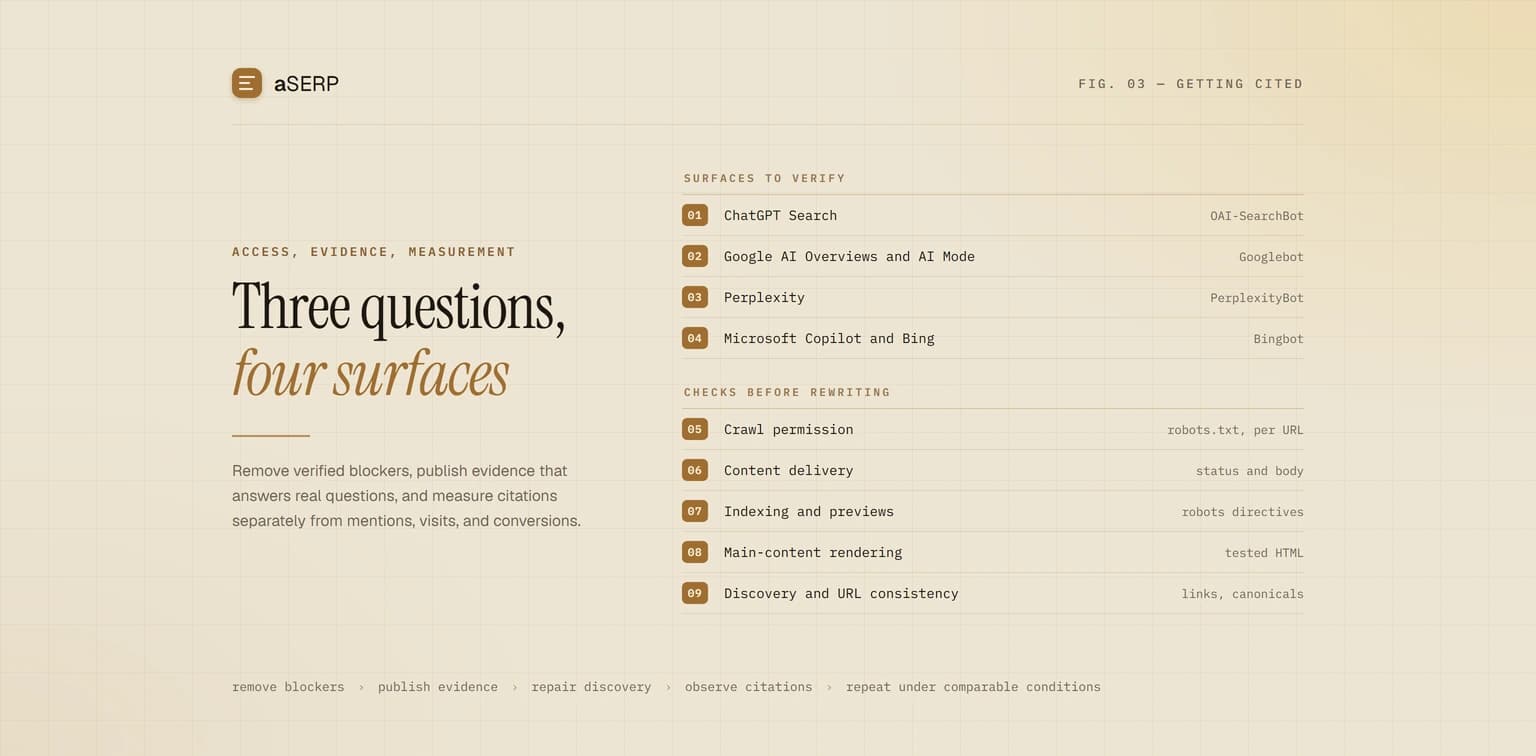
Start with three questions: Can the platform discover and access this page? Does it provide useful evidence for the question? Can we observe whether it is cited? This diagnostic gives your team a practical order of work without pretending to reconstruct a proprietary citation algorithm.
- Remove verified blockers. Check crawling, indexing, preview permissions, rendering, and firewall behavior.
- Contribute useful evidence. Publish something that helps answer the question beyond what existing summaries provide.
- Measure distinct outcomes. Track citations separately from brand mentions, visits, and conversions, using comparable observations before and after changes.
Define what “getting cited by AI” means
A brand mention means your company or product is named in an answer. A first-party citation links to a page on your own domain as a source. A third-party citation mentioning your brand links elsewhere, such as to a review or publication discussing your business. These are different outcomes, even when they appear in the same response.
A referral visit means someone follows a link to your site. A conversion is a subsequent action, such as a qualified inquiry, trial, subscription, or purchase. A citation without a visit is not traffic; a visit without a meaningful action is not a conversion.
This guide focuses on search-enabled or grounded answers: responses supported by retrieved information. ChatGPT’s documentation distinguishes citations from other relevant links in its Sources panel. For measurement, define whether you are counting answer-supporting citations, broader source-panel inclusion, or both, and label them separately. [4]
Model-training inclusion is a different objective. A model having encountered your content does not establish that a search experience can retrieve or cite your current page. OpenAI explicitly separates its search and training crawler controls. [2]
Check the requirements for each AI platform
Do not assume every assistant shares the same crawler, index, publisher controls, or search behavior. Apply the documentation for the exact surface you care about. [2] [3] [5]
| Platform or search surface | What publishers should verify | What this does not establish |
|---|---|---|
| ChatGPT Search | Permit OAI-SearchBot for intended public content and allow legitimate requests from OpenAI’s published SearchBot IP ranges. Treat training permissions separately. [2] | Selection for a question, preferred placement, or repeated citations. |
| Google AI Overviews and AI Mode | Confirm Googlebot access, indexing, snippet eligibility, and effective inclusion through Search Console’s Search generative AI control. [1] [5] [6] | An AI feature appearing for the query or your page being selected. |
| Perplexity | Permit PerplexityBot and check that firewall rules admit verified requests using the published IP information. [3] | Retrieval, citation, or citation prominence for a question. |
| Microsoft Copilot / Bing-supported AI surfaces | Check Bing crawl and indexing diagnostics, including URL Inspection, and applicable preview controls. [7] [8] | Inclusion across every Copilot product or partner experience. |
Separate search crawling, training, and user-triggered visits
OpenAI documents three different roles: OAI-SearchBot supports ChatGPT search; GPTBot crawls material that may be used for foundation-model training; and ChatGPT-User handles certain user-initiated visits. The search and training choices are independent. ChatGPT-User does not determine automatic Search inclusion, and robots.txt rules may not apply to its user-triggered actions. [2]
Perplexity similarly distinguishes PerplexityBot from Perplexity-User. Its documentation says the latter handles user-requested access and generally ignores robots.txt. Neither is described there as collecting content for foundation-model training. A successful user-requested visit is therefore not proof of automatic discoverability. [3]
Check Google’s effective Search setting
In Search Console, open Settings → Search generative AI. Verify the effective choice for the relevant property, including any setting inherited from a parent. Inclusion is the default, but a child property can inherit an exclusion. Google states that this control rolled out worldwide on August 31, 2026. It governs covered generative features, including AI Overviews and AI Mode, without acting as an inclusion or ranking signal for other parts of Search. [6]
Do not confuse this with Google-Extended. That robots.txt product token governs specified training and grounding uses involving Gemini Apps and Vertex AI. It has no separate HTTP user-agent identity and does not control Google Search inclusion or ranking. Google Search, the Gemini application, and the Vertex AI API are not interchangeable surfaces. [9]
Remove technical obstacles before rewriting content
Start with a confirmed symptom, not a speculative configuration change. The checklist below identifies what to inspect and what a successful result actually proves; the following sections explain the checks.
| Check | Typical symptom | Inspect | Success demonstrates |
|---|---|---|---|
| Crawl permission | A relevant URL is blocked | Effective robots.txt rules for that URL and agent | Automated crawling is permitted |
| Content delivery | Errors, challenges, or login screens | Verified requests, status codes, response bodies, and redirects | The tested request receives the intended page |
| Indexing and previews | A page or passage is unavailable | Index status, canonical choice, robots directives, and platform controls | Eligibility within the inspected system and chosen controls |
| Main-content rendering | A browser shows more than a fetch | Initial HTML and tested rendered output | The inspected path can read the explanation |
| Discovery and URL consistency | Orphaned or competing URLs | Internal links, sitemaps, redirects, and canonicals | A coherent route to the preferred resource |
Inspect crawl permission and the actual response
Check the live robots.txt rules for the specific URL and crawler rather than relying on a CMS checkbox. Follow redirects to the final response. Google’s minimum technical requirements include an unblocked Googlebot, an HTTP 200 response, and indexable content. [10]
Review content delivery network (CDN), web application firewall (WAF), and server logs for authentication failures, forbidden requests, rate limits, and server errors. Inspect the body too: an HTTP 200 response containing a bot challenge is not successful delivery of your article.
Verify crawler identity before granting an exception. Google publishes IP-verification and forward/reverse-DNS procedures; Perplexity recommends combining user-agent matching with its current published IP ranges. A familiar user-agent string alone is not sufficient evidence of identity. [11] [3]
Keep private content and unrelated security protections intact. Test the repaired public path again and record what was returned. A passing fetch is evidence of access, not indexing or citation.
Inspect indexing and preview restrictions
Use Search Console’s URL Inspection tool to examine the indexed page, crawl information, and Google-selected canonical. Run a live test separately when diagnosing the current version. The live result does not confirm that the version is indexed. [12]
Inspect both HTML robots directives and the X-Robots-Tag response header. In Google’s documentation, noindex prevents Search inclusion; nosnippet prevents text snippets and direct use of page content in AI Overviews and AI Mode; max-snippet can limit how much content is available as direct input; and data-nosnippet excludes selected text from snippets. The crawler must be able to fetch the page to read its page-level instructions. [13]
Bing also supports data-nosnippet to exclude designated content from snippets and AI summaries while leaving it indexable. An indexed page’s entire contents are not necessarily available for presentation. Remove only restrictions that conflict with your publishing intentions. [8]
Verify that the main explanation is readable
Compare the original HTML response with the rendered page. Search for a distinctive sentence from the main content. For Google, inspect the HTML available through URL Inspection’s tested-page view. [12]
Google can process JavaScript, but its guidance also recommends considering server-side rendering or pre-rendering because not every bot runs JavaScript. Do not assume another platform reproduces Google’s rendering behavior. [14]
Make essential explanations, specifications, pricing conditions, and conclusions available as meaningful text. A calculator or interactive comparison can still be useful; its essential assumptions and interpretation should not exist only after a visitor operates the interface. This is a practical resilience choice, not a universal citation requirement.
Repair discovery paths and conflicting URLs
Link important resources from relevant hubs and related pages. Keep sitemaps current, but do not treat submission as proof of crawling or indexing. Google describes a sitemap as a discovery aid, not a guarantee. [15]
Align internal links, redirects, and canonical declarations around the intended URL. Google advises against sending conflicting canonical signals. Check the canonical selected by the search engine, not merely the one declared in your HTML. [16] [12]
For participating engines, IndexNow can notify them when URLs are added, updated, or removed. It is a change-notification mechanism, not guaranteed indexing. Validate discovery by following the actual links and redirects to the intended resource. [17]
Publish evidence that answers real audience questions
Build a question list from support requests, sales conversations, interviews, site searches, and relevant search-performance data. Group questions by the decision or task behind them. Prioritize questions where your organization can contribute information it genuinely knows—not every topic adjacent to your product.
For each priority question, save a representative AI answer, open its cited URLs, and identify the supporting passages. Does a cited page offer a test, method, definition, specification, or comparison yours lacks? Does it state the relevant market, date, version, and limitations? Does it actually support the answer?
Use that inspection to find evidence gaps, not a template to copy. A source’s appearance suggests a hypothesis worth investigating, not a revealed selection formula.
Google recommends original information, research, analysis, and relevant first-hand expertise. Its generative-search guide similarly favors useful contributions over recycled summaries. These are documented Google recommendations; the following production methods are editorial recommendations, not claimed cross-platform ranking factors. [18] [1]
Publish research and first-hand tests with a reproducible method
Document the question, collection dates, sample selection, environment, versions, exclusions, and limitations. Release usable underlying evidence where privacy, permissions, and commercial obligations allow.
For example, test how several products handle the same export task. Record the tested plans, settings, input files, output checks, and failure conditions rather than announcing an unexplained winner. Distinguish an observed result from a conclusion about all customers or environments.
Validate the resource by asking someone uninvolved to reproduce selected tests and recalculate reported figures. A smaller, traceable dataset is more useful than an impressive number whose meaning cannot be checked.
Turn documentation into a procedure someone can complete
Include prerequisites, permissions, supported versions, inputs, expected outputs, common errors, and recovery steps.
A CSV-import guide could provide a sample file, required fields, accepted encoding, duplicate-handling rules, and a verification step. That gives readers a route from question to completion rather than a list of general recommendations.
Have someone who did not write the instructions perform the task from the page alone. Record where they need clarification, then fix those gaps.
Make comparisons fair and traceable
Choose evaluation criteria before scoring products. Compare equivalent plans and conditions, disclose relevant commercial relationships, and distinguish not tested from not supported.
For example, compare export formats, access controls, and billing conditions rather than simply declaring one product “best.” Explain which option suits which requirement, including situations where another product is a better fit.
Validate each comparison cell against documentation or a reproducible test. Assign an owner to review the page when products change.
Make commercial facts unambiguous
Maintain stable pages for product, pricing, and service information. Specify currency, billing period, region, plan, included usage, exclusions, and material conditions. Distinguish a monthly payment from a monthly equivalent billed annually.
Check claims against checkout, current documentation, and the actual service delivered. A clear pricing table is not enough when another page contradicts it. Keep the underlying facts consistent before polishing the wording.
Explain difficult decisions with qualified expertise
Ask someone with relevant experience to explain tradeoffs, failure modes, and boundaries. An engineer could explain when cached reports become stale, which settings affect refresh behavior, and when that explanation does not apply.
Validate through subject-matter review and supporting evidence. Label unresolved questions instead of presenting professional judgment as settled fact.
One substantial resource can answer related questions coherently. An import guide can cover encoding, field mapping, duplicates, and troubleshooting without becoming four near-identical pages. Google warns against scaling pages around every query variation primarily to manipulate rankings or generative answers. [1]
Write passages that make sense independently
Name the subject. Answer the question before adding background. Put dates, units, versions, conditions, and caveats beside the claims they qualify. Use tables when readers need to compare values and numbered steps when order matters.
These are communication practices, not a secret syntax for AI citations. Google explicitly rejects mandatory content “chunking,” special AI writing styles, and ideal page-length formulas. [1]
Example A: Replace vague marketing with useful facts
Before
Our powerful reporting platform gives teams effortless access to industry-leading insights.
After — illustrative product copy
Workspace administrators can export saved reports as CSV files. Each export contains the selected date range and applied filters. This export option does not include scheduled email delivery.
The rewrite identifies the user, action, output, and limitation. It makes no unsupported performance claim. These are fictional product details, not aSERP capabilities; publish equivalent wording only when it accurately describes your product.
Example B: Replace generic advice with a scoped diagnostic
Before
Make sure search engines can read your JavaScript website.
After — a Google-specific procedure
For a public JavaScript-rendered page, run Search Console’s URL Inspection live test. Open the tested page’s HTML and search for a sentence from the main article. Missing text warrants investigation. Present text confirms that the test saw that passage; it does not confirm indexing or citation.
This procedure follows Google’s URL Inspection documentation while keeping the conclusion within what the test demonstrates. [12]
Make claims verifiable and distribute legitimate evidence
Use genuine bylines and author profiles describing relevant experience. Explain how research or testing was performed, cite primary evidence beside the claims it supports, and make substantive updates when facts change. Google’s people-first guidance encourages clear authorship and transparency about production; it also cautions against changing dates merely to appear fresh. [18]
Do not turn trust into an invented “E-E-A-T score,” or present a third-party authority metric as an official AI-platform measurement. Google states that E-E-A-T itself is not a specific ranking factor. [18]
Use structured data where it accurately describes visible content and supports an applicable feature. Google requires no special Schema.org markup for AI Overviews or AI Mode. Adding markup does not replace missing evidence. [5]
For distribution, offer useful findings to relevant journalists, professional publications, partners, and communities. Provide the method and evidence they need to assess the work independently. Keep a clear first-party destination for the underlying resource, while recognizing that resulting coverage may become the cited source instead.
Manufactured mentions, fake reviews, undisclosed paid endorsements, and forum spam are not substitutes for evidence. Google specifically cautions against pursuing inauthentic mentions for generative-search visibility. A Reddit thread, Wikipedia page, or purchased link is not a universal shortcut. [1]
Measure AI citations without overstating the evidence
Establish your observation set before changing pages. Keep first-party platform reporting, sampled prompt tests, website analytics, and business outcomes separate. They answer different questions.
Build a repeatable observation set
Choose a manageable set of questions spanning discovery, comparison, and implementation. Separate branded prompts from unbranded prompts. Keep platform, language, and market segments identifiable rather than averaging them into one unexplained score.
For each observation, record:
- Test context: exact prompt, platform or surface, search mode, date, time zone, language, intended market, actual location context, and relevant account or personalization settings.
- Observed evidence: the answer, cited URLs, first-party versus third-party citations, unlinked brand mentions, and the associated source passages.
- Run status: usable response, technical failure, or—in an AI Overview study—a completed search with no overview. Record model information only when actually exposed; otherwise mark it unknown.
Repeat the questions on predetermined dates, preferably in fresh conversations with consistent settings. A new conversation alone does not eliminate personalization: OpenAI documents that location and saved memories can influence query rewriting. Language alone is not evidence of location. [4]
Do not insert your URL or ask the assistant to recommend your brand when measuring unbranded discovery. Those can be useful access or task-specific diagnostics, but they are different tests. Similarly, a prompt requesting “options in Spain” tests that stated context; it does not prove the run reproduces a Spain-based consumer session.
Treat an API probe as an observation of that API configuration. Do not relabel it as a consumer-app observation. Preserve the actual prompt and any changes made by your testing workflow.
Use first-party reporting for what it actually measures
Google. Search Console documents a Generative AI performance report covering organic link impressions in AI Overviews and AI Mode, with page, country, device, and date dimensions. This is not a prompt-by-prompt citation log. Missing report access does not establish zero visibility: the help page cites availability and impression thresholds. It also warns that unavailable values can export as zeros; preserve that distinction when interpreting downloads. [19]
Microsoft Bing. AI Performance reports citation activity across supported Copilot experiences, Bing AI summaries, and selected partners, including cited pages and sampled grounding-query phrases. The original February 10, 2026 announcement cautions that these counts do not establish ranking, authority, or placement. [20]
The June 16, 2026 update added Intents, Topics, Citation Share, and Compare in global preview. Bing defines Citation Share as citations attributed to your site divided by citations across all sites for the same grounding query. It is not response-based citation rate, traffic share, or a content-quality score. [21]
ChatGPT and Perplexity. Use clearly labeled prompt observations and identifiable referrals alongside any reporting available to your account. OpenAI documents the referral parameter utm_source=chatgpt.com. Perplexity’s crawler documentation is an access guide, not a publisher citation-performance report. Do not infer impressions or citation counts from crawler visits. [22] [3]
Define the denominator before reporting a citation rate
For your own prompt sample, distinguish these two measures:
A. Citation rate across valid responses
Responses citing the target domain ÷ all valid responses in the defined sample.
B. Citation rate among citation-bearing responses
Responses citing the target domain ÷ valid responses containing at least one external citation.
Illustrative calculation—not aSERP or customer results. A test on one search-enabled assistant produces 30 attempts: two technical failures and 28 valid answers. Fourteen answers contain external citations; seven cite the target domain.
| Measure | Calculation | Result |
|---|---|---|
| Rate A: across valid responses | 7 ÷ 28 | 25% |
| Rate B: among citation-bearing responses | 7 ÷ 14 | 50% |
| Technical failures | 2 of 30 attempts | Report separately |
The percentages answer different questions. Keep valid answers without citations in denominator A. Count each answer once even when it links to your domain repeatedly. Report either rate as not applicable when its denominator is zero. Preserve the raw counts beside the percentages.
For AI Overviews, also report the trigger rate: completed searches showing an overview divided by all completed searches. A search without an overview is not a technical failure or an invented AI answer. Calculate answer-level citation rates over actual overviews; label any additional rate over all completed searches as search-level exposure.
Define domain scope in advance: whether subdomains count, how redirects are resolved, and how duplicate links are handled. Retain the original cited URL as well as any normalized version so the observation remains auditable.
Connect citations to visits, accuracy, and business outcomes
Use analytics to inspect identifiable referral sessions, landing pages, and subsequent actions. Preserve useful attribution through redirects; ChatGPT’s documented UTM parameter provides one identification mechanism. Do not label all Google organic traffic as AI traffic, or assume a citation generated a visit. [22]
Measure qualified leads, purchases, and other meaningful outcomes separately. Show what you can attribute and leave the rest unknown rather than reconstructing missing journeys from assumptions.
Read the answer and its source together. Does the linked page support the associated claim? Were conditions or limitations omitted? OpenAI warns that search results and citations can be incomplete, outdated, or incorrect. A citation is not an endorsement. [4]
Finally, your prompt set is a sample, not the full audience. Keep test volume and conditions comparable, annotate changes, and repeat observations. A before-and-after increase is evidence to investigate, not proof that your edit caused it. Where feasible, observe similar unchanged pages too; that comparison can help identify broader shifts without establishing causation on its own.
Put the work into a 30-day implementation plan
Thirty days is a useful work cycle, not a promise that a platform will cite you within a month. Assign one owner to each change and preserve a dated record of the page version and validation result.
Days 1–7: Establish the baseline and remove verified blockers. Select representative questions and priority pages. Save initial answers, cited URLs, and available platform reports. Correct accidental exclusions, delivery failures, and unreadable main content. Retest the affected paths. The deliverable is a baseline log and a validated blocker list—not a general claim that the site is “AI-ready.”
Days 8–16: Improve a small set of source candidates. Match pages to specific audience questions. Add methods, first-hand observations, implementation instructions, precise commercial facts, or fair comparison criteria. Complete factual and technical review. The deliverable is a set of materially improved resources, each with an explicit reason it is more useful.
Days 17–23: Strengthen discovery and distribute useful work. Repair internal links, sitemap entries, redirects, and conflicting URL signals. Notify participating engines of substantive changes where appropriate. Share relevant evidence with legitimate publications, partners, or communities. Record placements separately from first-party citations.
Days 24–30: Repeat observations and choose the next iteration. Rerun the same questions under comparable conditions. Compare cited pages, representation accuracy, platform reporting, referrals, and business outcomes. Check whether updated content has been fetched where this is observable. Document the remaining constraint and choose the next test.
Diagnose pages that still are not being cited
Before commissioning more content, ask whether the page directly answers the observed question, including its market, date, and conditions. A broad article may discuss the topic without supplying the specific fact or procedure the answer needs.
Then compare its evidence with the pages actually cited. Is yours current, first-hand, and traceable? Is the strongest information trapped in vague sales copy, an image, a gated file, or an interactive interface? Are you expecting a first-party product page to answer a question better served by an independent comparison?
Finally, distinguish an unobserved result from a verified failure. Check access, indexing where observable, the fetched version, and whether the sample is large and consistent enough to show a pattern. “Not observed in our sample” is defensible. “Invisible to AI everywhere” usually is not.
Frequently asked questions
Can a small or new website earn AI citations?
Yes, it can be eligible. OpenAI says any public website can appear in ChatGPT search. A new site may still need stronger discovery paths; Google identifies new sites with few external links as a case where sitemaps can help. Start with specific questions where you can supply useful first-hand evidence. [22] [15]
Must a page rank first in Google?
No first-position requirement appears in the cited Google guidance. Google specifies indexing and snippet eligibility alongside its current inclusion control. It also describes related searches, or query fan-out, when assembling AI answers. Results for the original question are therefore not a complete list of possible supporting sources. [5] [6]
Must I allow training crawlers to earn search citations?
Not as a blanket rule. OpenAI allows OAI-SearchBot independently of GPTBot. Google-Extended does not control Google Search inclusion or ranking. Make training and search-access decisions separately rather than assuming one permission buys the other. [2] [9]
Do llms.txt or structured data guarantee citations?
No. Google says Search ignores llms.txt for visibility and requires no special schema for generative search. Use structured data to describe visible content accurately and meet applicable feature requirements—not as a citation switch. Do not generalize Google’s llms.txt statement into a claim about every AI product. [1] [5]
Should the evidence live on my website or elsewhere?
Choose according to the outcome. Publishing the authoritative resource on your site creates a first-party destination. Independent coverage can introduce it to another audience, but an assistant may cite that coverage instead. Track both without treating them as interchangeable or requiring every mention to link back to you.
How long should I wait before evaluating changes?
Verify technical repairs through appropriate tests first. OpenAI describes roughly 24 hours for Search crawler robots changes; Perplexity says its crawler-setting changes can take up to 24 hours. These are propagation estimates, not citation deadlines. [2] [3]
For content changes, check for recrawling and collect repeated, comparable observations. Google’s recrawl-request guidance describes days to weeks and makes clear that a request does not guarantee inclusion. Its preview-control guidance notes that some page refreshes can take longer. No source here promises a cross-platform citation timetable. [23] [5]
The practical objective is not to make an assistant repeat your brand name. It is to publish a source worth using, remove obstacles to accessing it, and measure what happens without overstating the evidence. Start with one important question, one page that can answer it better, and one baseline you can repeat.
References
Official documentation and first-party announcements. All sources checked September 6, 2026. In-text reference numbers link to the entries below; source titles and URLs open the original pages.
[1] Google Search Central. Optimizing your website for generative AI features on Google Search
https://developers.google.com/search/docs/fundamentals/ai-optimization-guide
[2] OpenAI. Overview of OpenAI Crawlers
https://developers.openai.com/api/docs/bots
[3] Perplexity. Perplexity Crawlers
https://docs.perplexity.ai/docs/resources/perplexity-crawlers
[4] OpenAI Help Center. Searching the web with ChatGPT
https://help.openai.com/en/articles/9237897-chatgpt-search
[5] Google Search Central. AI features and your website
https://developers.google.com/search/docs/appearance/ai-features
[6] Google Search Console Help. Search generative AI control
https://support.google.com/webmasters/answer/16908024?hl=en
[7] Microsoft Bing Webmaster Tools. URL Inspection
https://www.bing.com/webmasters/help/url-inspection-55a30305
[8] Microsoft Bing Webmaster Blog. Bing Introduces Support for the data-nosnippet HTML Attribute
https://blogs.bing.com/webmaster/October-2025/Bing-Introduces-Support-for-the-data-nosnippet-HTML-Attribute
[9] Google Crawling Infrastructure. Google’s common crawlers — Google-Extended
https://developers.google.com/crawling/docs/crawlers-fetchers/google-common-crawlers#google-extended
[10] Google Search Central. Google Search technical requirements
https://developers.google.com/search/docs/essentials/technical
[11] Google Crawling Infrastructure. Verify requests from Google crawlers and fetchers
https://developers.google.com/crawling/docs/crawlers-fetchers/verify-google-requests
[12] Google Search Console Help. URL Inspection tool
https://support.google.com/webmasters/answer/9012289?hl=en
[13] Google Search Central. Robots meta tag, data-nosnippet, and X-Robots-Tag specifications
https://developers.google.com/search/docs/crawling-indexing/robots-meta-tag
[14] Google Search Central. Understand the JavaScript SEO basics
https://developers.google.com/search/docs/crawling-indexing/javascript/javascript-seo-basics
[15] Google Search Central. Learn about sitemaps
https://developers.google.com/search/docs/crawling-indexing/sitemaps/overview
[16] Google Search Central. How to specify a canonical URL with rel="canonical" and other methods
https://developers.google.com/search/docs/crawling-indexing/consolidate-duplicate-urls
[17] IndexNow. Frequently asked questions
https://www.indexnow.org/faq
[18] Google Search Central. Creating helpful, reliable, people-first content
https://developers.google.com/search/docs/fundamentals/creating-helpful-content
[19] Google Search Console Help. Generative AI performance report (Search)
https://support.google.com/webmasters/answer/16984139?hl=en
[20] Microsoft Bing Webmaster Blog. Introducing AI Performance in Bing Webmaster Tools Public Preview
https://blogs.bing.com/webmaster/February-2026/Introducing-AI-Performance-in-Bing-Webmaster-Tools-Public-Preview
[21] Microsoft Bing Blog. New AI Visibility Insights in Bing Webmaster Tools: Intents, Topics, Citation Share, Compare
https://blogs.bing.com/search/June-2026/New-AI-Visibility-Insights-in-Bing-Webmaster-Tools-Intents-Topics-Citation-Share-Compare
[22] OpenAI Help Center. Publishers and Developers — FAQ
https://help.openai.com/en/articles/12627856-publishers-and-developers-faq
[23] Google Search Central. Ask Google to recrawl your URLs
https://developers.google.com/search/docs/crawling-indexing/ask-google-to-recrawl